Looking back at your preliminary task, what do you feel you have learnt in the progression from it to the full product?
Preliminary Task Brief
Continuity task involving filming and editing a character opening a door, crossing a room and sitting down in a chair opposite another character, with whom she/he then exchanges a couple of lines of dialogue. This task should demonstrate match on match action, shot/reverse/shot and the 180-degree rule.
Main Task Brief
The titles and opening of a new fiction film, to last a maximum of two minutes. All video and audio material must be original, produced by the candidate(s), with the exception of music or audio effects from a copyright-free source.
What have I learnt?
During the course of the project, I have learnt many things, but one thing that stood out for me was the fact that careful planning can easily be thwarted by unreliable actors. Both of our initial actors had to be dropped because their prior commitments meant that waiting for them would have been an illogical decision. Jasmine, who was to be our Jessica, was busy with music and Gabriel, who was Angus, seemed to be all over the place, sometimes he was there and other times he cancelled for something else. When we were doing the preliminary task, because our actors were group members, they could be relied upon to be there on time and be reliable for the job. In addition, for the main task, three of the members from our prelim group were already together; me, Narishma and Olivia, which meant that the group already knew how to work together well.
Our initial test shoot
We had a back up plan, however, to use Eoin and Olivia, just in case something like this happened, so we managed to finish our project in time, as we had about 2 weeks to film and edit the whole thing. The reason we had so little time was because of the afore mentioned actors, who caused us to keep pushing back our shoot schedule. Apart from this, I have also learned important skills in After Effects, such as how to key out a green screen, as well as creating titles and applying effects in post production, which will be important for me if I decide to go into film or TV as a career.
What did we do well? What could we have done better?
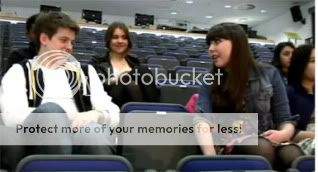
I think we all managed to keep a cool head in the face of adversity. When we had to deal with our actors, we made our decisions quickly and swiftly. I also think that our pencil scene is rather well done. It looks real enough from a distance, so it really looks like Angus was lifting it with his mind. I know that there are several continuity errors in our sequence, for example, when Angus sits down on the chair after everyone has left, as well as head positions of the extras during the cuts. Another problem is that some of the extras looked at the camera, for example, during the zoom into Jessica’s face, one of the extras kept looking at the camera and fidgeting, making her really noticeable.
The girl in the middle looks noticably awkward
If I were to redo this, I would make sure that all the extras were professional and check and double check our shots on shoot to make sure that we can fix any potential continuity errors, as well as taking a lot more takes.
Editing the sequence
Another thing we could have done better was to create a proper storyboard after we decided on the final final sequence, because the idea changed so much after I’d drawn the initial storyboard that during the shoot, we didn’t even use the storyboard, we used the shot list to check our clips and see if we had all the material we needed to make a complete sequence.
I think we have done really well as a group, we got on with our work and had almost no arguments, avoiding most of them by remaining professional and focussing on the project instead of petty nitpicking. We met on a consistent basis to ensure that all the jobs we needed to get done were split evenly amongst the group. For example, much of our writing up was left for Narishma to do because she is the most organised of our group while all the creative processes, such as storyboards and character sketches were for me to do because I'm the artist in our group.
Original character sketch for Angus
I mentioned that my planning and organisational skills were improved by the prelim and I think it shows because my work is a lot more organised and orderly this time around.
What have you learnt about technologies from the process of constructing this product?
In order to construct our film opening, we used various technologies, of which can be separated into hardware and software.
It was necessary to use a lot more than just a simple camcorder. We needed a tripod to do steady shots, a boom mic to pick up sound from further away and a boom pole to holster it, a battery to power the camera and a smaller one to use as back up, two tapes and headphones to check the sound. We also used several studio lights in order to illuminate our shots and give them more depth.
Although we didn’t use it in the final sequence, we used the manual setting on our cameras in order to practise focus pulling, which we accomplished after a few tries. There were several settings on the camera, such as white balance, or colour correction that we didn’t use because the shots didn’t need them.
In the process of using the lights, we learned that in order to illuminate a shot, you need a minimum of 3 lights, two in the front and one behind to cancel out the shadows. I also personally learnt that handling the ‘barn doors’ on lights without gloves is a bad idea.
Another thing we learned was that compatibility was an issue with some of the technology, for example, the headphones we used didn’t work with the camera, meaning that we ended up with static from the speakers. The microphone still picked up the sound, but we weren’t able to check it, so we had to hope it worked.
I used three pieces of software during production and post production, Adobe Photoshop, Adobe Premiere Pro and Adobe After Effects. With Photoshop, I coloured in the initial pencil sketches of the character designs, as well as colouring in the drawings for the opening credits. I also used filters to create the comic style effect (we called it the Lichtenstein effect).
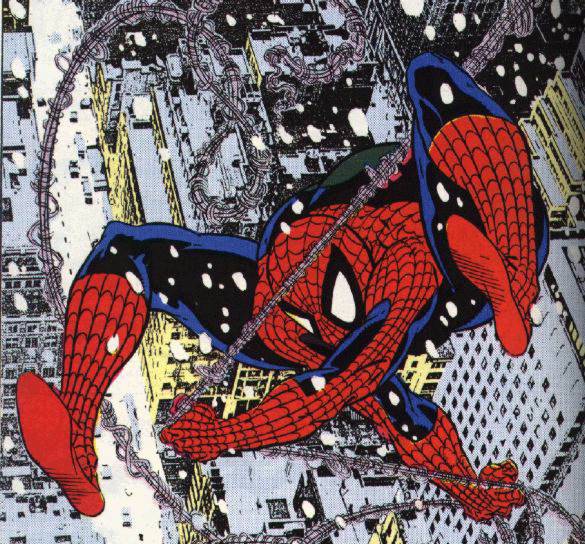
I created the entire opening credit sequence in After Effects. I used shapes as the crawling bars and motion paths to make them move across the screen, mimicking the Spiderman 2 webs. I had to play with the speeds and paths of most of the bars in order to shorten the sequence. The first version was about a minute long, which is about half our sequence. The revised version was about 35 seconds. The problem with After Effects was that music didn’t work in it for some reason, meaning that I couldn’t fit the titles to the music. Another problem we faced initially was that the names of the actors passed slightly too quickly. We later rectified this in Premiere, by using Time Warp and adjusting the speed of the clip in little segments.
I used a black shape to use as a transition. One picture would be covered and then the next would be revealed a few seconds later. I then added a green screen to the last bar, so that as it passed, it would reveal the first shot of the scene.
In Premiere, in addition to capturing, inserting into the timeline and cutting down, things I learned from my year 10 TV trailer. I also had to adjust the volume and start position of all the music in order for it to work properly in the sequence. For example, during the pencil sequence, the music peaks just as Jessica says ‘Hello’. The music had to crescendo into something epic, but also had to end appropriately so that it didn’t seem like we’d picked random bits of music.
In addition to the Adobe software, I also used a blogging website (Blogger) to keep a log of what I’d done in the way of production and post production, as well as a place to write up my thoughts and ideas. We also used the internet to find our music, a site called Audio Network (http://www.audionetwork.com/).
With our film opening, we aimed to appeal to our audience in a number of different ways. For example:
The narrative makes it easy for our audience to empathise with Angus, because it’s the kind of situation that a lot of people have experienced. The fact that Angus is really awkward and weird makes people pity him. This also invokes schadenfreude, because the audience feels better about themselves when they watch Angus being bullied.
Our opening sequence is quite similar to the Spiderman 2 opening. Worldwide, Spiderman 2 grossed over $783.7 million, the 3rd highest grossing film of 2004. Since our film is of the same genre, our audience will be expecting the same kind of thing from our film. We share many of the same things, for example, the unexpected hero and the love interest from school.
Our sequence contains of lot of SFX to astound and entertain our audience, the best example being our pencil lift effect, but the transition from cartoon to real Angus at the end of the credits, as well as the ghost effect at the end are also good examples.
By using the title Exceptional, we have immediately suggested that the film has something to do with superpowers. Audience then watch the film because they expect certain conventions, for example, the downtrodden unexpected superhero saving the day and getting the girl.
So as you can see, our film opening has definitely managed to appeal to our audience, as most of them understood what the film was about. However, many of them also didn't understand the opening credits, some thought it was a premonition of the future whereas some of them thought it was unrelated.
During the initial stages of planning, we decided on a target audience that would be easy to appeal to. Since our genre was superhero, our core audience was almost decided straight away, because the majority of superhero films are aimed at our audience.
CORE TARGET AUDIENCE
13-20 Year Old Males
Acquainted with technology
From around the comic book generation
Interested in the realistic aspect of superheroes - e.g. Dark Knight
What aspects/features of our film appeal to this audience?
Different and more believable superhero
Instead of the same old comic book, standard superhero action comedy our film will be more in line with superhero drama (similar to Misfits)
Offers escapism
SECONDARY AUDIENCES
Due to a number of factors our film could appeal to a wide range of audiences because there is something for everyone, we tried to use the idea that 20th Century Fox had with Avatar (2009) in order to ensure that the film has a wide reach.
The factors are:
Love Interest/ Romance storyline = appeal to teenage girls
Action = appeal to the fans of action films
Realism/Unsuspected Superhero = those who want to see something different
Mise-en-scene (locations and costume) = anyone can relate to how he is feeling at some point during the film
What kind of media institution might distribute your media product and why?
Our film opening was produced by Offbeat Productions, an independent British film production company that makes films that aren’t necessarily mainstream, reflected by the use of offbeat, a term used in music to denote a beat that is out of sync of the rest of the melody, metaphorically representing how our company makes films different to everyone else. Recently we have been trying to branch out from an exclusively British audience to a wider, more global audience.
I think our film should be distributed by a global distributer, such as Warner Bros., which distributed films like Superman and the critically acclaimed Dark Knight, both of which are of the superhero genre. Another potential distributor might be Fox Searchlight (or rather, Box Spotlight), which specialises in British indie films.(picture of website?)
Due to the mainstream nature of the superhero genre, I believe that the best venue to show our film at would be a popular cinema, such as Odeon or Cineworld. A specific example of a Cineworld would be the Enfield Town Cineworld, which receives over 500 visitors a day during the holiday season.
However, recently, with the proliferation of high speed broadband and Web 2.0, uploading the film to the internet is becoming more of a viable option as technology improves. A quick and free way to distribute our film would be to upload it to YouTube. YouTube has become more and more prevalent in modern society, almost every news channel has their own page and there’s even a section for filmmakers now. It has a global reach, getting over a billion hits per day. One video has over 172 million views by itself. (screenshot of front page)
How does your media product represent particular social groups?
Our film opening uses several genre conventions, as well as a few teenage and gender stereotypes. For example, our protagonist superhero is male, like the majority of superheroes out there (Batman, Superman, Spiderman, Deadpool etc.).
In addition, Jessica wore a floral dress, as well as having a bright pink coat, flowers and pink both being associated with girls. Later on in the film, she is also a damsel in distress. However, she is also higher in authority than the bullies, as she forces them to stop harassing Angus.
Bully on the left
One of the bullies is wearing an American jock jacket, which fulfils the stereotype that jocks are bullies and stand on a pedestal of power. He throws a paper ball at Angus’ head, laughing and high fiving his friend when he does. This is inverted, however, when he stops bullying Angus after Jessica admonishes him for doing so. Stereotypically, jocks are the ones in charge of their relationship; in this case, women are given more power over men.
Angus wears a long black trench coat, the coat symbolising the wall separating him and the rest of the world. This separation is further alluded to when the sketch he drew comes to life, shaking its head. Angus is shown to be a socially awkward teenager, a figure we can empathise with because we’ve been in his place before. His social awkwardness is emphasises when he stares at Jessica, to the point where she notices and feels creeped out by it. The comic style freeze frame with the love hearts around it also makes it feel like Angus is in his own little world.
In what ways does your media product use, develop or challenge forms and conventions of real media products?
Our fiction film opening definitely uses standard forms and conventions of real superhero films. We have followed many conventions of a real opening sequence. We took a lot of inspiration from Spiderman 2 and Kick-Ass. For example, conventions we followed:
·Two of the main characters are introduced during the sequence, Angus and Jessica.
·The drone of a teacher in the background, as well as the fold down chairs suggests a lecture hall and/or a university.
·Our sequence has various titles, including the names of our actors as well as specific positions such as director and producer. John Solomon isn’t a real person, but he does have a specific role; later on in the film, he would have played the villain.
We also followed conventions of our genre: superhero. We haven’t especially broken the mould with this; we’ve used common stereotypes, as well as using some less used ones, for example:
·A voiceover from the main character
·Comic book styled drawings, quite an unorthodox way to tell his backstory (similar to Spiderman 2)
·The “average” super hero, someone you don’t expect to be one (Peter Parker, anyone?)
·The love interest, almost always popular and pretty. Usually a damsel in distress as well. (Mary Jane Watson)
·Telekinesis, one of the original super powers
Aside from conventions, we have also used narrative techniques in order to sequence our opening. For example, we have followed Todorov’s theory of equilibrium:
·The Agents – Angus, Jessica and the mad TV presenter.
·The Equilibrium – Angus lives the life of an average teenager, bullied at school and in love with a girl who’ll never look his way. However, there is one thing that he’s good at…
·The Disruption – Jessica is kidnapped by a crazy TV presenter, who thinks it’ll give him the last scoop he needs. No one in the school but Angus seems to care though.
·The Journey – Angus uses his powers to get into the mansion where the presenter is holed up in order to rescue Jessica.
·The New Equilibrium – Angus and Jessica start going out, the presenter is arrested and locked up and Angus gains the confidence to deal with the bullies in his own exceptional way.
We have also used things like continuity editing to give the sense of a real time sequence, which is really important both film and TV film and TV, as well as things like crossfading to make it seem like more time is passing, as well as disorienting the audience and adding to the eerie build up of music. Our title sequence is quite similar in style to the Spiderman 2 opening, with the lines crawling over the comic style drawings and revealing names of actors and film staff.
1) Who did you work with and how did you manage the task between you?
Group 1E consists of Frank (me), James, Narishma and Olivia. Me and James were the actors in the sequence, while Narishma was the director and Olivia was on camera and sound. Prior to shooting, much of the preparation work was done by Narishma and me. Narishma organised everything and took notes, whilst I was the one who drew the storyboard. James and Olivia pitched in with ideas. During editing, we all did approximately a quarter of editing each, with the others chipping in during the process. In preparation for this evaluation, James created the shot list, Narishma typed up the shooting schedule, Olivia typed up the script and I scanned in the storyboards and checklist.
From left to right: James, the baby, Olivia, Narishma, Me (Frank)
2) How did you plan your sequence? What processes did you use? What theories did you take into account?
We planned our sequence initially by discussing and brainstorming ideas for the plot we wanted in our group, while I drew our planned shots into our storyboard, which consisted of pink post-its on paper. We used the post-its so that we could move around our storyboard in case we changed our minds about the shot order. Then when we finalised our storyboard, I redrew the post its onto a proper storyboard.
During shooting, we also used a shooting schedule to organise our time accordingly, so that we did all related shots together, for example, all the indoor shots in the same area together so as to save time. Doing this ensured that we finished within the hour we had to shoot the sequence.
We also applied Todorov's theory of equilibrium to our sequence.
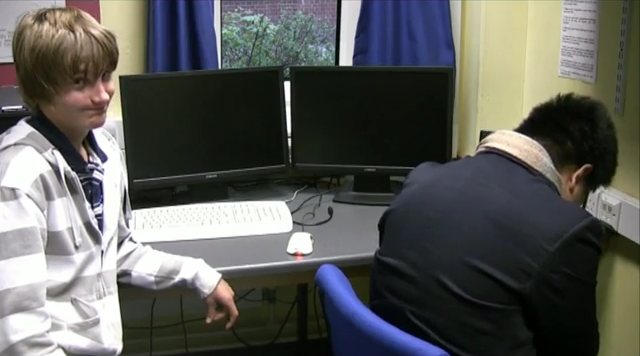
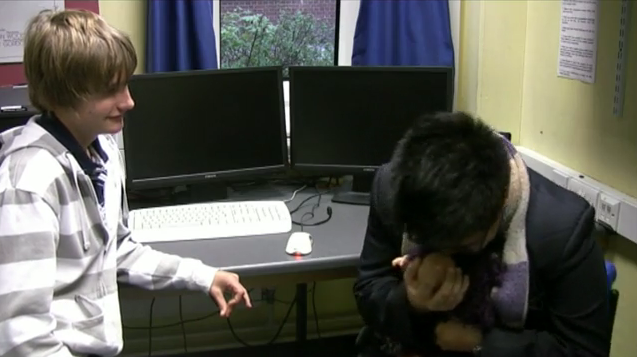
Initial Equilibrium -> Disruption -> Disequilibrium -> Final Equilibrium Man inside alone with baby toy -> Arrival of second guy -> Second guy arrives too late -> First man upset.
Shot reverse shot and 180 rule
However, the theory we focused on the most was the theory of continuity editing, since that was the basis of our sequence, to create a short sequence that complied with the rules of continuity. The main facets of continuity we followed were the 180 degree rule, where we made sure that we didn't go over the invisible line between actors, so as to ensure that the audience wouldn't get confused by a sudden jump in perspective.
Match on action
Additionally, we also employed quite a lot of match-on-action to create a seamless feel, to make it smooth and flow properly. Match-on-action is where action from the previous shot matches what happens in the next shot, so the sequence appears to be in real time. For example, opening a door, you would cut from someone starting to push the door, to a close up of the hand on the door handle and then cut to the door opening from the other side. We also tried to stick to the 30 degree rule, where every cut has to move the camera more than 30 degrees, otherwise the audiences experiences a slight jump in angle, which feels strange and can often confuse the audience. Finally, we applied a shot-reverse shot in our sequence, to exaggerate the awkward silence and also make sure that it flowed well. The consistent cuts ensured that the audience understood what was happening, that the silence was in the same time period and that we hadn't progressed in the narrative yet.
3) What technology did you use to complete the task and how did you use it?
Shooting the outdoor scene
with camera and shotgun mic
We used a standard video camera on a tripod to film the sequence, but for this task, we also were given a shotgun microphone attachment to use as well. With the shotgun mic, we had 3 settings, but only used two of them, the shotgun setting and the ambient 1 setting. The shotgun setting is supposed to be used for interviews or things directly in front of the camera whereas the ambient 1 setting turns on the mic on the back of the attachment to pick up more of the background sounds. We used this function to create the ambience of a school, using the ambient setting when shooting outside to pick up the background noise. This background noise was cut out by the doors so there wasn't any noise when shooting indoors. Unfortunately, the shotgun mic also recorded the quietest sounds there, so it picked up another group speaking next door and a lot of static as well, so our sequence is riddled with static.
Our editing station
In addition to the camera equipment, we also worked with Adobe Premiere Pro CS3, the editing software of choice. With this, we used several tools, mainly the razor tool. Razor cuts up a film clip into two seperate clips where you click. This is used when you want to remove unneeded bits of video, for example, removing all other takes of a sequence except the one you want. Using the razor tool, we were able to precisely cut our sequence so it matched up exactly as we wanted it to, which required liberal use of the zoom tool and a lot of discussion between the group about what looked best. As we were able to match each shot to each other, we were able to create match-on-action, which was crucial for the continuity of our sequence.
4) What factors did you have to take into account when planning, shooting and editing?
All in all, we had 3 hours to do this task. 1 to plan, one to shoot and one to edit. In that time, we had to create an entire sequence and edit it to make it flow properly and correctly. So time was one of our biggest problems. Before shooting we had to use our shooting schedule to make sure that we saved as much time as possible so that if anything went wrong, we could redo the shot. We also had to plan ahead for human memory. Originally we were going to use a stuffed bear as the prop instead of the doll, but the person who was meant to bring it in forgot. We had planned beforehand to use the doll instead, so we didn't hit too big a roadblock. In addition, we had planned to have the room in darkness, and then James would turn the light on, but we eventually decided that this would complicate matters and make the editing process much more complicated. It would also mean that we would have to play with the lighting, since the room would have been too dark otherwise, so in the end, we decided to forgo this.
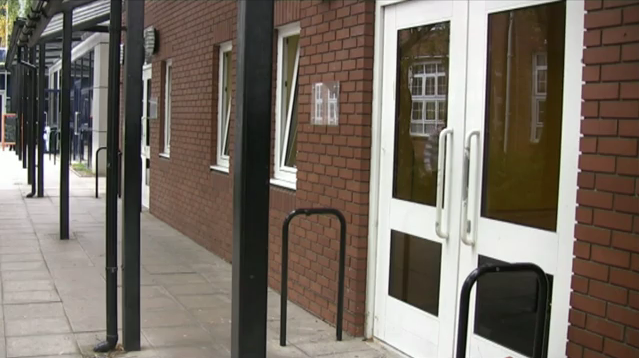
The offending Media block. From our establishing shot.
During shooting, we had to take into consideration several things. Firstly, since we were filming in a school, we had to make sure that we didn't get any random students in the background. As it happened, we started filming just as the bell went, so there was a large influx of students walking to their classes. Luckily, there were relatively few around the Media block so the problem passed fairly quickly. However, a more significant problem was the sound. As mentioned earlier, the shotgun mic was quite possibly too effective. We picked up a lot of static and another group speaking in the room behind us. We decided to let it go, seeing as "it's a school, there's supposed to be noise". With regards to the shooting, we had to ensure that continuity was kept in mind. When doing each take, I had to make sure that I turned around at the same speed, that I said my lines at the right time. James had to keep his walking consistent and his facial expressions as bemused as the last. That way we ensured that the continuity remained as it should be.
The only factors during editing were time and continuity, which we didn't have much of a problem with, we just got on with it. There was a slight discrepancy when I was turning around, as we had cut between two shots where the 30 degree rule was broken, leading to a slight jump in perspective. We all thought it looked a bit peculiar, but no one could put their finger on it. That was quickly solved by intervention from our teacher. We removed a clip and re-edited it and the end result flowed much better than it did initially.
5) How successful was your sequence? Please identify what worked well and with hindsight, what would you improve/do differently?
I believe that our sequence fulfilled the terms of the brief successfully, as we had several techniques of continuity and completed all the actions to do. We have a match-on-action, a character opening a door, sitting down and having a conversation with another character. We have also followed the 180 and 30 degree rules, ensuring that the audience never loses track of the narrative flow.
Whoops. We broke the fourth wall
In addition, we have also successfully applied our genre, which was comedy, to the sequence. This is made as such by the stroking of the doll, the awkward silence, which is amplified by the sudden cut to the doll's face and the abruptness of the crying. The silence builds up the tension, as well as the expression on the scarfed character's face implying that he's getting more and more irritated. You expect an explosion of anger, as opposed to bursting out crying. To top it off, at the end of the sequence, we break the fourth wall when James looks at the camera with a bemused expression.
However, our sequence isn't good either. Given the time to go back and revisit it, we would have done several things differently. Sound is a significant issue. As mentioned before, the sequence was absolutely full of static. If we had time to remove the soundtracks of each clip and record our voices on a professional microphone to remove the static. If a microphone was out of the question, I could have run the sound clip through a filter on Audacity (a music editing program) to remove the static.
Whoops.
We dun goofed
We also have a slight jump cut at about 0:41 in the sequence, which is caused by an audio jump and a breaking of the 30 degree rule. This disorientates the audience and it breaks them out of the narrative. Since we were running short on time, what might have been okay isn't, since the audio jumps and the shots jump as well. We matched the action, but the audience is still disorientated. This is where we messed up during filming. We didn't get enough shots of me swivelling around in the chair and the ones we did have had me doing different things. In one of them, I just leaned down and cried, but on the other I was rocking back and forth. So if we could redo this, we would have made sure that all our shots had enough takes and also made sure they matched action properly so that our sequence flowed perfectly.
6) What have you learnt from completing this task? Looking ahead, how will this learning be significant when completing the rest of your foundation coursework, do you think?
By doing this task and successfully completing it, I have learned several new things. I have learned that during the planning, shooting and editing processes, it is always important to plan ahead to prevent potential disasters and also consider continuity, because the loss of continuity means the loss of audience comprehension and understanding and quite possibly interest. We must always apply these continuity rules, lest our sequence be a failure.
Also, I have learned the specific manner in which we must progress prior to filming. We must check sound and camera, only filming when there are no problems with either. In case of a problem, we cannot continue filming, since we would damage either the equipment or the quality of the final sequence.
During this exercise, I have also learned that the key to a sequence is simplicity. Many students will, on their first attempts, try to create the flashiest sequence possible, to show off their talents and skills. Doing so could very well result in a very high quality, entertaining sequence, but most of the time just means more work and more complications. Time is precious during a shoot. It can't be wasted messing around trying to get the perfect shot angle, or getting that one object to fall exactly right. By keeping it simple, we reduce the time needed for each shot, we reduce the strain on resources and we make our jobs much much easier. Simplicity also helps in the planning stages, as the simpler the ideas, the more you can brainstorm during the initial phase, meaning you have more options to try out, so if one idea turns out to be a dead end, you can try another.
Thus, what I have learned will be important to future tasks as it will have helped me with my organisational and planning skills, so that come a significant project, I'll have no problem brainstorming and planning time. All these skills will result in a high quality, entertaining sequence that never breaks continuity.